CITY & STUDENT LIFE

Understand Kunming before choosing a university

A practical study and living guide for international students — not a collection of slogans.

01 · City & study

The Spring City, and China's gateway to Southeast Asia

Kunming (昆明) is the capital of Yunnan, sitting about 1,900 metres up on the Yunnan–Guizhou Plateau beside Dianchi Lake (滇池). Because of the altitude and the low latitude, it has no real winter and no unbearable summer — which is why it is called the "Spring City" (春城). It is also the most culturally mixed large city in China: Yunnan is home to 25 recognised ethnic minority groups, and Kunming is the country's land gateway to Laos, Myanmar and Vietnam, with a large South and Southeast Asian student population.

  • Good fits: biology and ecology, ethnology and area studies, medicine and public health, agriculture and forestry, business and finance (Yunnan University, Kunming Medical University and Yunnan University of Finance and Economics cover these well).
  • Choosing a university: Chenggong (呈贡) is the new university town south of the lake, where most large campuses have moved; Wuhua (五华) and Panlong (盘龙) are the older central districts with the traditional campuses.
  • Living here: the climate is the easiest in this guide, but the altitude means strong sun, dry air and a real day-night temperature swing. Budget for sunscreen and a jacket you carry even in the afternoon.
Illustration of studying and living in Kunming
Kunming's mild air comes from the plateau — the same altitude that gives it strong sun and cool nights.
02 · Climate & packing

Mild all year — but "a rain turns it into winter"

Kunming has a low-latitude plateau monsoon climate: the annual average is around 15 °C, January usually sits near 8–10 °C and the hottest summer days rarely pass 25 °C. There are really only two seasons that matter — a dry season (roughly November–April) with clear skies and cool nights, and a rainy season (roughly May–October) when most of the year's rain falls, often as short afternoon showers. The local saying is "四季如春,一雨成冬" — four seasons like spring, but one rain and it is winter — because a shower can drop the temperature fast. Ultraviolet light is genuinely strong at this altitude, even under cloud.

What to packHigh-factor sunscreen and sunglasses — this is not optional; a light waterproof layer you carry daily through the rainy season; a warm jacket for evenings and for winter nights; layers rather than heavy coats; and lip balm, because the dry season is dry.

Kunming mild plateau climate and what to pack
03 · Your first week

Sort the paperwork first, then acclimatise

  1. Confirm where and when to register, as stated in your admission notice
  2. Check into your dormitory or complete accommodation registration
  3. Complete the document checks, medical examination and insurance your university requires
  4. Set up your campus card, SIM card, bank card and everyday payment apps
  5. Locate the campus clinic, the international student office and emergency contacts
03
04 · Daily life

Metro for the city, buses and shared bikes for the lake

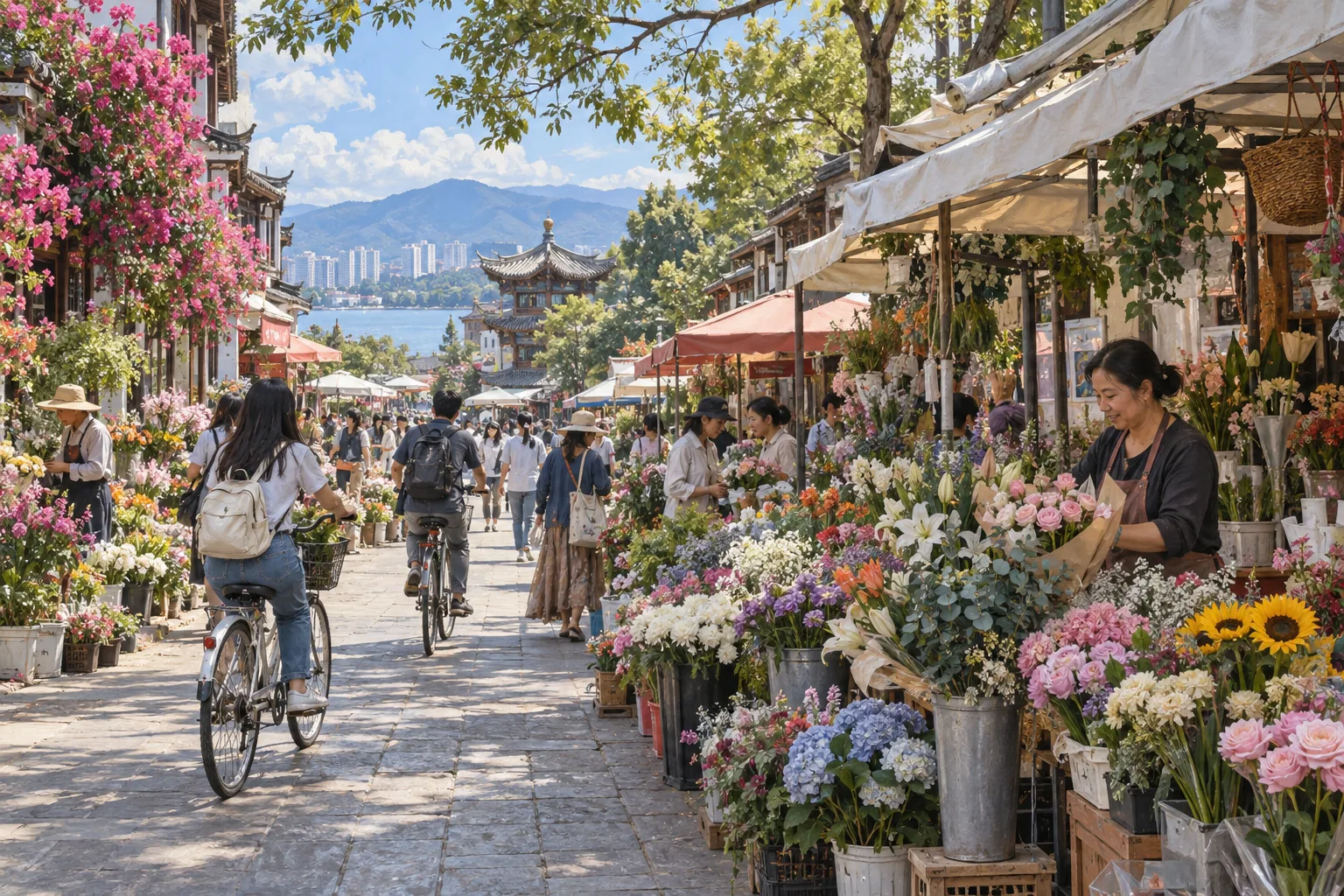
Kunming's metro now reaches the airport, the main railway stations and the Chenggong university town, and it is the fastest way across a city that has grown quickly. Shared bikes are genuinely useful here because much of the central city is flat. The city's rhythm is outdoors: Green Lake Park (翠湖) fills with migrating red-billed gulls from Siberia every winter, Dianchi Lake and the Western Hills (西山) are the standard weekend trips, and the Dounan flower market (斗南) is one of the largest flower markets in Asia — worth seeing once even if you never buy anything.

First-week goalRide the metro to the city centre and back on your own, set up a metro QR code, eat once in a campus canteen, buy sunscreen, and save the international student office's phone number.
Kunming metro, Green Lake Park and student life
05 · Budget & housing

Confirm your housing first, then work out monthly costs

On-campus places, room types and opening dates are arranged by the university. Chenggong's newer campuses generally have larger dormitories but sit well south of the old centre, so check the commute before choosing. Off-campus rents in Kunming are among the lowest of any provincial capital in this guide, though newly built districts near the universities have risen. Once you are admitted, apply for a dormitory early if you want one.

Do not overlookDormitory application deadlines, move-in documents, off-campus accommodation registration, and whether you can stay during holidays.
05
06 · Culture & belonging

A plateau city of many peoples, and a wartime university

Yunnan's ethnic diversity is not a museum exhibit here — it is the everyday texture of the province, and Kunming is where it converges. The Yunnan Nationalities Village and the provincial museums are the formal introductions, but the real thing is the food, the festivals and the languages you will meet on campus. Kunming also has a remarkable modern chapter: during the Second World War it was the terminus of the Burma Road, and from 1938 to 1946 the wartime National Southwestern Associated University (西南联大) — Peking, Tsinghua and Nankai merged and relocated — taught here, producing an extraordinary generation of Chinese scientists and writers. The old campus site is now on the Yunnan Normal University grounds.

What this means for youUniversity life in China is more formal than in many countries. Address teachers as "老师 (lǎoshī)" and older students as "学长 / 学姐 (xuézhǎng / xuéjiě)"; punctuality and preparation are noticed; open public criticism is rare, but "face" (面子, miànzi) matters, so feedback is often indirect. Join a 社团 (club) or the 留学生办公室 (international student office) activities early: most of your classmates will be Chinese, and that is where friendships and daily-language practice actually happen.
Kunming ethnic culture, Dianchi Lake and the Western Hills
07 · Food, faith & festivals

Rice noodles, steam pots — and a serious mushroom warning

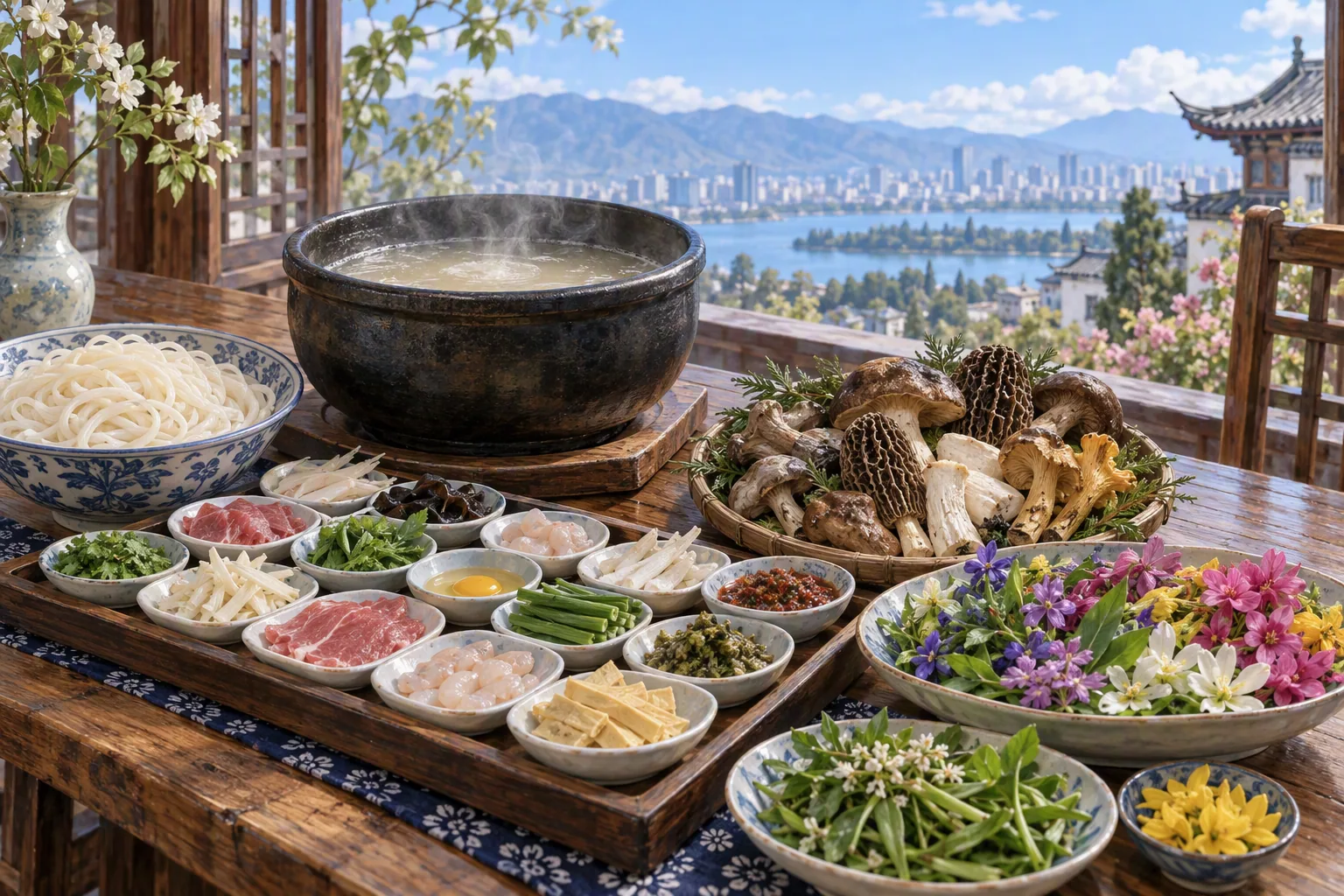
Yunnan cooking is unlike the rest of China: it leans on herbs, flowers, cured ham and freshwater fish rather than heavy sauces. The dish everyone knows is 过桥米线 (crossing-the-bridge rice noodles), served as a tray of raw ingredients you add to a bowl of scalding broth; also try 汽锅鸡 (steam-pot chicken), 宣威火腿 (Xuanwei ham), 饵块 (rice cakes) and 鲜花饼 (flower cakes) made with edible roses. One genuine safety point: the wild mushroom season (roughly June–September) is a local passion and a real hazard — every year people are hospitalised after misidentifying toxic fungi. Eat wild mushrooms only in reputable restaurants, never from a street stall or self-picked.

Kunming has a long-established Hui Muslim community, with mosques and 清真 (halal) restaurants concentrated around the old city near Shuncheng Street, so halal food is easier to find here than in most Chinese cities. Festivals shape the academic year: 春节 (Spring Festival, usually late January–February) shuts campuses for weeks, so book travel home early; 国庆 (National Day, 1 October) brings a week-long holiday and very crowded transport; Yunnan's own minority festivals — notably the Dai Water-Splashing Festival in April — are regional holidays worth planning around. Freedom of belief is protected; for any prayer or worship space, confirm arrangements with your international student office rather than assuming.

Kunming crossing-the-bridge rice noodles and Yunnan dishes
08 · Apps, money & safety

Set up the everyday toolkit in your first days

  • WeChat (微信) — chat and group notices, plus WeChat Pay; universities push announcements here and you scan to pay in canteens and taxis.
  • Alipay (支付宝) — Alipay Pay and transit codes for metro/bus; both apps accept major international cards for visitors, but keep some cash as backup.
  • 高德地图 / 百度地图 (maps), 滴滴出行 (ride-hailing), 12306 (train tickets), 美团 / 饿了么 (food delivery).
Two rules that are law, not adviceIf you stay anywhere other than a registered hotel or your dorm, you must register your address with the local police station (派出所) within 24 hours of arrival. X1-visa holders must convert their visa to a student residence permit at the Kunming Exit–Entry Bureau within 30 days of entry. If you plan to travel onward to Laos, Myanmar or Vietnam, check your visa situation with the international student office before booking — border rules are not the same as airport rules. Emergency numbers: police 110, ambulance 120, fire 119, and the Kunming service hotline 12345.
08