CITY & STUDENT LIFE

Understand Xiamen before choosing a university

A practical study and living guide for international students — not a collection of slogans.

01 · City & study

A garden island facing the Taiwan Strait

Xiamen (厦门) is a coastal city in Fujian province, built on an island and the mainland shore facing the Taiwan Strait. It has a mild, green, seaside character — it is regularly ranked among China's most liveable cities — and a deep maritime and overseas-Chinese heritage: for centuries it was a major port, and the nearby Jimei district and the island of Gulangyu were shaped by the philanthropist Tan Kah Kee, whose name runs through local universities. Xiamen University sits on a celebrated seaside campus in Siming district, and the city's economy spans electronics, shipping, tourism and trade.

  • Good fits: economics and management, accounting, finance, statistics, chemistry, marine and environmental science, journalism, law, and Chinese-language study (Xiamen University has long-standing international programmes).
  • Choosing a university: Xiamen University now spans Siming (main), Xiang'an and Zhangzhou campuses; Jimei University sits on the mainland in Jimei district — confirm how far your campus is from the island centre.
  • Living here: a mild coastal climate, a relaxed and clean environment, and a strong overseas-Chinese and international-student community that makes settling in easier.
Illustration of studying and living in Xiamen
A seaside campus city — mild, green, and outward-looking.
02 · Climate & packing

A mild maritime climate with a typhoon season

Xiamen has a humid subtropical maritime climate — mild winters and warm, humid summers, moderated by the sea. Summer is long, hot and wet, and the city lies in the typhoon belt: from roughly July to September, typhoons can bring heavy rain, strong wind and occasional transport disruption. Winter is short, mild and rarely cold. Spring and autumn are pleasant, and greenery lasts all year.

What to packLight summer clothing, rain gear and quick-dry shoes, a light jacket for the mild winter, sun protection, mosquito repellent, and a habit of checking typhoon alerts in late summer.

Xiamen's coastal climate and what to pack
03 · Your first week

Sort the paperwork first, then start exploring

  1. Confirm where and when to register, as stated in your admission notice
  2. Check into your dormitory or complete accommodation registration
  3. Complete the document checks, medical examination and insurance your university requires
  4. Set up your campus card, SIM card, bank card and everyday payment apps
  5. Locate the campus clinic, the international student office and emergency contacts
03
04 · Daily life

A compact, walkable city with excellent public transport

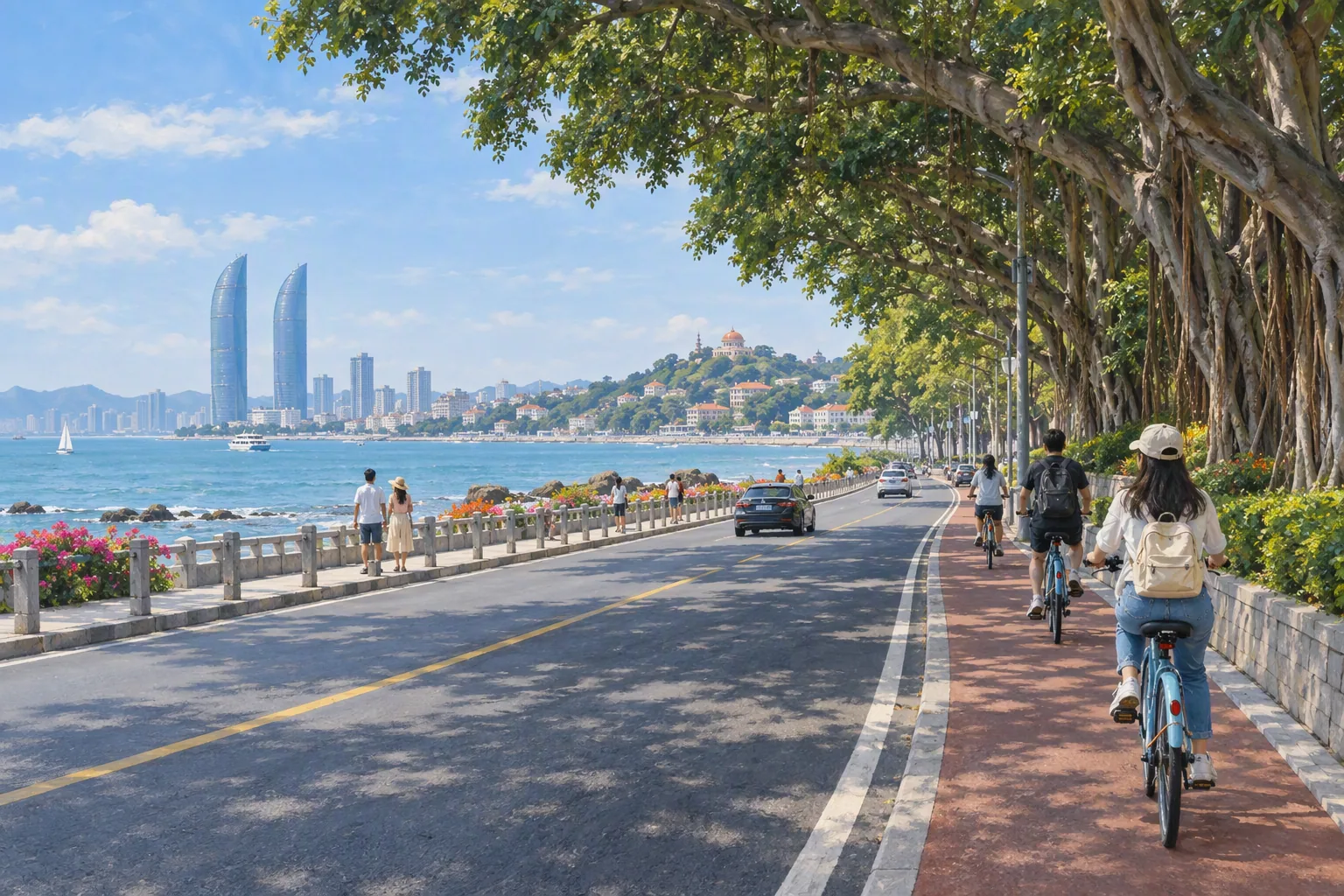
Compared with China's megacities, Xiamen is compact and easy to navigate: a metro, buses and a large shared-bike network make getting around simple, and the island's seaside paths are pleasant to cycle. The city is clean and green, with a strong café and seafood culture. Xiamen University's campus is a short walk from the coast, and the ferry to Gulangyu is a well-known local ritual. Costs are moderate — higher than inland cities but below Shenzhen and Shanghai.

First-week goalTake a bus or metro from campus to a market and back, try a bowl of shacha noodles, set up a transit code, and save the university's key contacts.
Daily life and seaside paths in Xiamen
05 · Budget & housing

Confirm your housing first, then work out monthly costs

On-campus places, room types and opening dates are arranged by the university. Xiamen's living costs sit between the inland cities and the coastal megacities. The Siming campus area is central and convenient; Xiang'an and Zhangzhou campuses are further out, so check the commute if you consider off-campus housing. Apply for a dormitory early if you want one.

Do not overlookDormitory application deadlines, move-in documents, off-campus accommodation registration, and whether you can stay during holidays.
05
06 · Culture & belonging

Gulangyu, Tan Kah Kee and a global overseas-Chinese story

Xiamen's culture is maritime and outward-facing. Gulangyu (鼓浪屿), a car-free island of red-roofed colonial villas and banyan trees, is a UNESCO World Heritage Site and known as the "Island of Music" for its piano heritage. The Nanputuo Temple (南普陀寺) sits at the foot of Xiamen University's campus, and the Jimei School Village on the mainland is a remarkable complex of schools, halls and gardens built by Tan Kah Kee (陈嘉庚), the overseas-Chinese philanthropist who founded both Xiamen University and Jimei University. Because Xiamen is a historic homeland of overseas Chinese, international and returned-overseas students are a familiar part of campus life here — which can make the social transition gentler than in less international cities.

What this means for youUniversity life in China is more formal than in many countries. Address teachers as "老师 (lǎoshī)" and older students as "学长 / 学姐 (xuézhǎng / xuéjiě)"; punctuality and preparation are noticed; open public criticism is rare, but "face" (面子, miànzi) matters, so feedback is often indirect. Join a 社团 (club) or the 留学生办公室 (international student office) activities early: most of your classmates will be Chinese, and that is where friendships and daily-language practice actually happen.
Xiamen Gulangyu island and Nanputuo Temple
07 · Food, faith & festivals

Fujian seafood and Minnan flavours by the sea

Xiamen's cooking is Minnan (闽南, southern Fujian) seafood: 沙茶面 (shacha noodles, in a peanut-and-seafood broth), 海蛎煎 (oyster omelette), steamed and stir-fried seafood, 花生汤 (peanut soup), and a strong bubble-tea and dessert culture. Because of the overseas-Chinese connection, the city also has a distinct Southeast-Asian-influenced food thread. Halal (清真) restaurants are available; Buddhist-vegetarian food is common near temples. Campus canteens are cheap and seafood-heavy, and delivery is easy.

Festivals shape the academic year: 春节 (Spring Festival, usually late January–February) shuts campuses for weeks, so book travel home early; 国庆 (National Day, 1 October) brings a week-long holiday and crowded transport; 中秋 (Mid-Autumn) — marked locally with the 博饼 (bobing) dice game, a Minnan tradition — and 端午 (Dragon Boat) are celebrated with dragon-boat races on local waters. Freedom of belief is protected; Nanputuo Temple and the city's mosques and churches welcome respectful visitors. For any prayer or worship space, confirm arrangements with your international student office rather than assuming.

Xiamen food: shacha noodles and seafood
08 · Apps, money & safety

Set up the everyday toolkit in your first days

  • WeChat (微信) — chat and group notices, plus WeChat Pay; universities push announcements here and you scan to pay in canteens and taxis.
  • Alipay (支付宝) — Alipay Pay and transit codes for metro/bus; both apps accept major international cards for visitors, but keep some cash as backup.
  • 高德地图 / 百度地图 (maps), 滴滴出行 (ride-hailing), 12306 (train tickets), 美团 / 饿了么 (food delivery).
Two rules that are law, not adviceIf you stay anywhere other than a registered hotel or your dorm, you must register your address with the local police station (派出所) within 24 hours of arrival. X1-visa holders must convert their visa to a student residence permit at the Xiamen Exit–Entry Bureau within 30 days of entry. Keep a photo or scan of your passport, visa and admission notice on your phone. Emergency numbers: police 110, ambulance 120, fire 119, and the Xiamen service hotline 12345.
08